If you read my post about my experience at the LA Times Festival of Books this past weekend, you know that I went to an awesome panel about writing memoirs. On this panel was author Sandy Allen, who discussed at length what it was like to write their book. Despite my belief prior to the panel that I would exclusively be excited by Michael Ausiello, Sandy definitely changed that for me. When they spoke, I dove head first into their words, eating them up hungrily.
Many things Sandy said stood out to me, but there was one comment in particular that I clung to. They mentioned how, in graduate school, their peers and friends would spend every day writing. Sandy wouldn’t understand, exclaiming “What do you even have to write about?!,” not able to figure out how they came up with content to write every single day. Unlike their peers, Sandy had a different writing method.
Their approach is different than the one I’ve heard over and over about the writing industry; that you must always be writing. Sandy, instead, takes breaks (imagine that!) and writes when there is content to write about. And not all days are spent hunched over a Word document; some days are spent researching or interviewing subjects, and are just as productive as the days spent writing. Hell, some days are for going to the beach and stepping away from your project for a little while.
In case you all forgot, or just haven’t been paying attention, I am a perfectionist. I made this a daily blog to help decrease my perfectionistic tendencies, like spending weeks on the same essay, and allowing myself to post even the smallest of posts. However, lately, that has equated to me pushing myself to generate worthy content every day, which isn’t always easy. Not only that, but I fight my perfectionism on what I post. Some days, I think I have to continue to write pieces that will continue to captivate my audience and increase my blog views. Which, of course, goes against why I created this blog in the first place.
So, when I left the Festival of Books this weekend, I came home and reread the “About” page of my blog. Because it’s all about how I created this site for me. Not for the audience, or for a certain number of daily page views. Sandy had reminded me that it is ok to go at my own pace, and take breaks when I need/want them. The blog won’t vanish if I don’t post every day, and people won’t stop reading if every once in a while I post something that isn’t exactly profound.
This post is for me to remember that my worth and my perfectionism do not go hand in hand. In fact, my worth is so far from what my perfectionism tells me, it’s absurd. This is also a reminder to you, that it is perfectly ok to take breaks and not beat yourself up over the small stuff. Stress and pressure will come and go, but you want to make sure you are doing what you are doing for the right reasons. Don’t let the thing you love take your mind for a ride without your permission. Nothing is perfect. Neither are you.
*If you are a reader (and even if you aren’t), I encourage you to go pick up a copy of Sandy Allen’s book, “A Kind of Mirraculas Paradise: A True Story About Schizophrenia.” I’m only a few pages deep and I’m hooked. 10/10 would recommend.
This weekend I was in Los Angeles attending the LA Times Festival of Books, aka, my own personal heaven. I attended panels by beloved authors and poets, met new people, took many pages of notes, and peed in a hot port-a-potty. It was a weekend fueled by creativity, coffee, and the desire to learn as much as possible.
In a way, this weekend was both terrifying and exhilarating. I felt drawn in to the high of art and writing and creating; the authors before me had been successful, why couldn’t I? Each panel delivered unique advice that I scribbled in my notebook as fast as my hand could move. I felt prepared in a way I hadn’t before; reassured that I was doing everything “right,” even though art knows no right or wrong.
At the same time, I felt like a grain of sand at the bottom of the ocean. There was so much talent surrounding me, and the eloquence that poured off of the lips of these writers intimidated me. How could I write something as profound as them, or even come close? As I listened to them describe their writing processes and meeting deadlines for their editors, I was overwhelmed. My head swam with toxic thoughts of incapability and impossibility; how would I ever be able to do anything like this?
Like waves lapping on shore, my stress ebbed and flowed. One poet during the first panel of my weekend adventure mentioned that he was not “a sophisticated thinker” like the others he was sitting next to. And yet, I was captivated by his perspective and story, and felt more connected to him than the others. I remember thinking, “Well he claims he’s not a sophisticated thinker and neither am I. But if he can get this far, maybe I can, too.”
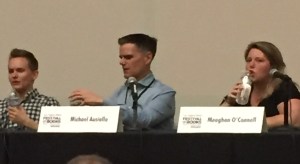
The panel I had been waiting for all weekend arrived, and I was fighting through some gnarly GI symptoms that I had woken up with that morning. I’d be damned if I let my chronic illness stop me from being in the same room as the author of one of my favorite memoirs. I popped some Pepto, took a deep breath, and braced myself for “Memoir: The Unexpected Hard Stuff,” with authors Sandy Allen, Michael Ausiello, and Meaghan O’Connell. With my notebook in my lap, and my pen poised, I was ready to absorb everything they had to offer.
I ended up not taking notes at all, too enthralled with what each author was saying to bear ripping my attention away, even for a moment.
iPhone realness: L to R, Sandy Allen, Michael Ausiello, Meaghan O’Connell
Each panelist spoke beautifully about their process and challenges they faced while writing their respective books. I was fascinated by Sandy’s story; their book was written over a period of 8 years after their uncle had shipped them a messy manuscript of his life and his schizophrenia. Sandy spoke beautifully about what it’s like to write nonfiction, and all of the hard work that is required to do justice to a person’s life.
Michael spoke next about how difficult it was for him to write about something so tragic, so traumatic, so soon after the death of his husband (which is what his memoir is about), and yet, how writing helped him make sense of the tragedy and how he felt his late husband’s story deserved to be told. He wanted to introduce the world to the man he loved. How powerful stories can be that each person who approached Michael that day, hands slightly shaking as they handed him their own precious copy of his book to be signed, had (or will have) their own experience while reading it. Each took something different from each page compared to myself or anyone else waiting in line, waiting for the author to crack open the cover and write them a message on the title page of his book.
Never would I have thought that at the LA Times Festival of Books, in front of a panel of esteemed writers, I would overcome a major social anxiety exposure. At the end of each panel, there is time for a few questions from the audience. As I am always fearful of how I will be judged or perceived, I usually keep my mouth shut in situations like this. But three brilliant writers were sitting across from me, having accomplished what I strive for in writing about my pain. I couldn’t leave without speaking to them directly.
I had my question ready the moment the moderator sent the first question down the line; each author responded very differently to how they crafted their work, and how long it took them to write about things that are painful. My perfectionism kicked in, as I realized my question lacked form in most respects, but I let go of that judgment so that I wouldn’t miss any of what was in front of me because of the chatter in my head.
I found myself fully present in listening to each author’s response, though my heart would skip a beat when I thought about my question. I was worried I would forget it and make a fool of myself. In previous panels, audience members who wanted to ask questions at the end of the panel were brought a microphone to their seat by the volunteers of the festival. You could stay seated or stand, and I was comfortable with this. I could ask my question while still remaining “safe” next to my friend, in my seat. I was still blended into the crowd. But of course, the universe knew I was working through an anxiety exposure, so when it was time for the Q&A, those who had questions were asked to step down to the very front to whichever microphone was closer- there was one stationed on the left and right of the stage.
Hell no, I thought. I was not about to embarrass myself by standing in front of everyone and asking my not-yet-fully-formed question. How would I stand? Would I cross my arms as I waited behind the other woman with poofy blonde hair who had already positioned herself at the mic closest to us? Would I draw my hands together behind my back, or should I let them fall by my side like limp noodles? Seeking final reassurance, I leaned over to my friend as the woman on our side addressed the panel. “I want to ask a question, should I go up there?” I whispered, as inconspicuous as I could manage. I didn’t want to come across as disrespectful by talking in the middle of the Q&A. My friend smiled and nodded vigorously as the poofy-haired woman wrapped up her question and stepped away from the microphone. I slipped out of my seat and down towards the stage, praying that I looked confident despite my strong desire to become endowed immediately by Harry Potter’s invisibility cloak.
I wound up being the last question of the day, an honor I received anxiously, as I peered around to make sure someone with a more eloquent or pressing question was waiting in the wings behind me. There was no one. All eyes were on me, and I was the only one in the room standing. I smiled awkwardly, leaned in towards the microphone, and began to speak.
The mic wasn’t working. No one could hear me. Of course the microphone wasn’t working! Michael looked at me and said, “Use the microphone!” to which I nervously called back, “I don’t think it’s working.” So, naturally, the moderator had the girl with social anxiety cross in front of the entire audience, directly in front of the panel (including the author she admires), to the microphone on the other side of the stage. When I had finally obtained a working mic and the audience had died down after the laughter that ensued my impromptu runway walk in front of everyone, I cleared my throat and began to speak. This time, my voice echoed through the lecture hall, and I made eye contact with Michael.
I definitely rambled, but managed to form my question in a way that could actually be responded to. If memory serves, it went something like this:
“I’ve heard before that when writing about trauma, there is a Three Year “Rule” to abide by; you should wait three years after the traumatic event to begin writing, to give yourself some distance and perspective on the experience. I was so interested in the time it took you and Sandy to write your respective books, and how different each process was. I’m curious, do you think if you had waited until after you had gotten some distance from the tragedy, you would have produced a similar result? What is your opinion on the difference between waiting or writing during the grieving time?”
With quivering legs I waited for his answer. The moderator jumped in by “correcting” the Three Year Rule I had mentioned; “That’s not really a ‘rule’ necessarily,” she said to me, causing me to blush and my anxiety to rise. Of course, I had not planned on following the so called “rule” that I had heard the day before, but was merely curious about how writing about personal trauma is different for everyone. I pushed away the thought that people in the audience were judging me for mentioning this Rule, and focused on what Michael had to say.
First, he thanked me for telling him that I had loved the book (I wasn’t sucking up, I genuinely loved it. Everyone go out and buy yourself a copy.) and then dove into his answer. He mentioned how he wouldn’t have written the book had he waited. Writing it so soon after his husband’s death gave him a fresh perspective; the memories were still vibrant in his mind, and he knew that if he waited, he wouldn’t get the opportunity to tell his husband’s story the way it deserved to be told.
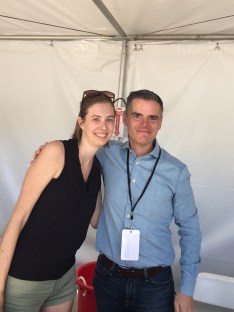
This ended up being the response that catapulted me into a discussion with Michael at the signing afterwards. I expressed how writing through pain and chaos is a way for me to make sense of what I’m going through, and ultimately, helps me get through it. I ended up telling him I’m in treatment for an eating disorder, and if I didn’t write about it, I would be in a very different place. I was able to tell one of my favorite authors that his book helped me through a very difficult time, and that I was so grateful to him for writing it. It was a great ending to a phenomenal (albeit, stressful) morning.
Meeting Michael Ausiello
This festival as a whole was so brilliantly designed. Each panel audience stocked with seasoned readers and writers, as well as those who didn’t know who most of the authors were, but were curious about their topic at hand. (Except for the man who fell asleep and started snoring during the Poetry: Trauma and Beauty panel…maybe he had just had a long day.) From the nerds to the newbies, there was something for everyone; some piece of advice or line from a book or poem that someone grabbed onto and will keep in their memory bank forever.
That is what great art is about. Everyone will interpret experiences differently, and that is the beauty and power of great literature, art, poetry, theatre, film. The world is endless, and I am small in a sea of stories waiting to be told.
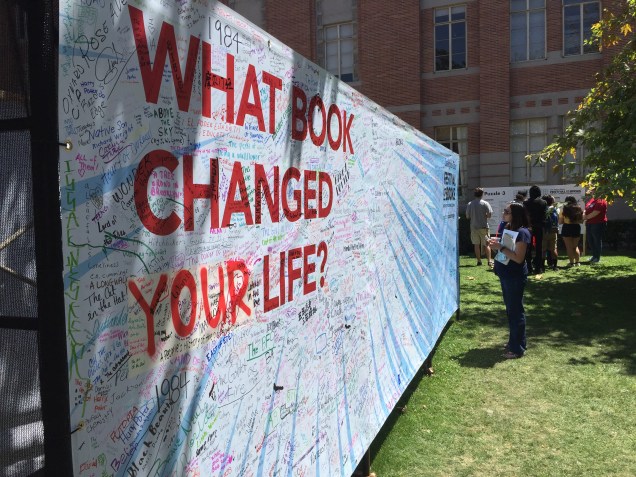
My contribution to this wall: “The School Story,” a children’s novel by Andrew Clements. It was the first book that gave me hope as a young girl that I could be a writer.
PS- I originally wasn’t going to disclose the book I wrote on the wall above for fear of being judged for it (#socialanxiety) but my copy of this book is worn with pages falling out because of how many times I read it growing up. Hell, I read it a few weeks ago to find some inspiration, and it was just as good as the first time I read it. The book that changed your life doesn’t have to fit a certain mold or be any profound piece of literature. It can be something as simple as a children’s novel that sparked inspiration and power within you.
Books You Must Read:
Spoiler Alert: The Hero Dies Michael Ausiello A Kind of Mirraculas Paradise: A True Story About Schizophrenia Sandra Allen And Now We Have Everything: On Motherhood Before I Was Ready Meaghan O’Connell
blood is not paint
sharp edges are not a paintbrush
art is not defiling your body
with scars and bruises
it is not as beautiful as you think
there are other things more exquisite
take the sun
setting over the ocean
melting its rays into the
churning water
or a mountain silhouetted
against a pink and purple sky
as if it is not a natural creation
or a painting made of watercolor
capturing a woman mourning
the loss of her home
art can be painful
but art is not created
at the expense of physical pain
you do not shed blood
to become more beautiful
you are beautiful
you are art
in its most natural form
Hello all! A #MentalHealthMonday post is forthcoming, don’t you worry, but I wanted to make a quick announcement first.
I am adding a new poetry collection to my site! In addition to the unnamed series, I will be writing pieces reflective of my work towards recovery, particularly from my eating disorder. I will be writing when I am in wise mind, and the focus will be on the importance of recovery, that I can look at when I’m feeling willful. I want to channel my creativity, because that tends to draw me in more and be more inclined to share and express what I’m feeling or going through.
So, I hope you enjoy it! I appreciate your readership!
i stare dead into the face
of my disorder
it is beautiful
a ravenous glow
that makes me hungry
for the beauty it possesses
it pulls me towards it
stimulated
i sway towards the light
moving through a thick fog
when from behind i feel
my name trickle into
my consciousness
the glowing light in front of me
suddenly flares as i
turn to the direction of
the voice
the light so blinding
it’s hard to make out shapes
colors seem distorted
there it is again
my name like silk
like something familiar
calling me home after a long day
through the ether hanging like a
curtain upon my eyelashes
a form materializes
and i can make out
an outstretched hand
i walk towards it
the warmth from the mass of light
behind me flutters
against my skin
as i spot another form
another hand stretched towards me
welcoming
comforting
the two forms are shoulder to shoulder
when another joins them
and another
until there is a sea
an army
reaching out for me
and i realize
they aren’t anonymous creatures
they are women
each with a distinct aura
all radiating care and love
they seem resistant to the illumination
that i have left in my wake
and their hands seem soothing
like a still pool of water
the heat continues to shroud me
yearning for me to reciprocate
and envelop it’s rays
yet there is something so magnetic
that allows me to reach out
and grasp at the closest hand
there is a slight shudder
a disturbance in the temperature
and the woman reaches up
with her other hand
and douses my eyes
with her fingers
washing away the curtain
and i feel a change
a match struck
when i turn to face
the warm glow of my disorder
i find that it is a roaring fire
sparking and spitting
angrily towards me
i look down at my clothes
they are singed and smoking
falling from my body like ashes
it’s as if a kaleidoscope is removed
from my vision
changing the soft light
to an inferno
that was burning me alive
engulfing my existence
i step back into the arms of the
women that surround me
forming a wall that withstands
the increasingly burning ugliness
cooling my skin as they
barricade me from the blaze
they guide my mind
teaching me how to
douse the flame
-to the army of women on staff at my treatment center. this is for you.
This #MentalHealthMonday is a doozy for me as I fight to #endthestigma and challenge my perfectionism and social anxiety. TW: self-harm.
Growing up I struggled with self-harm; Sasha constantly told me that I would be more beautiful with bruises and scars covering my body, so I did as she said and destroyed my body, again and again. And she was happy, again and again. It wasn’t until I saw a therapist here in San Diego and admitted to what I was doing that I realized it was wrong. Sasha was mad that I had shared our secret, so she made me feel exponential shame, which she soothed by convincing me to hurt myself once more. The cycle continued.
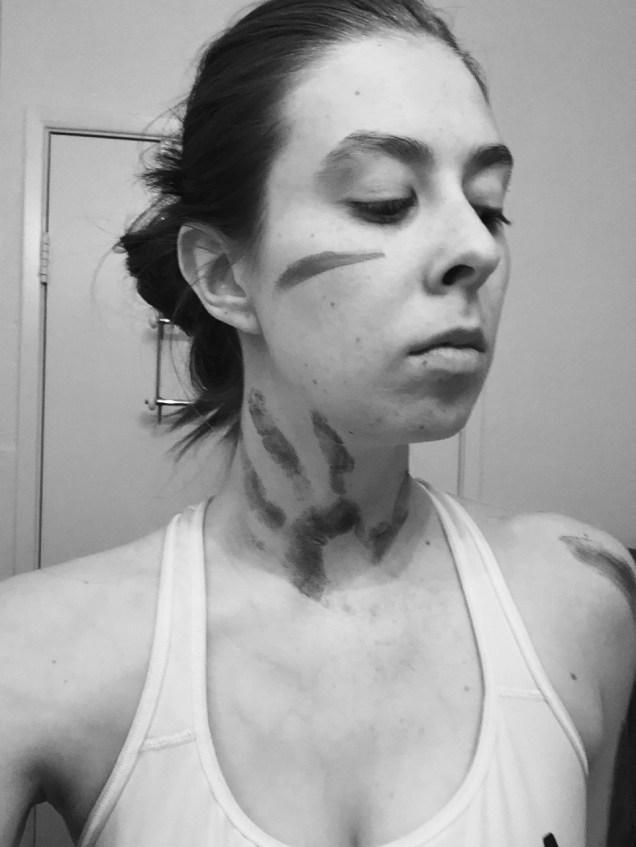
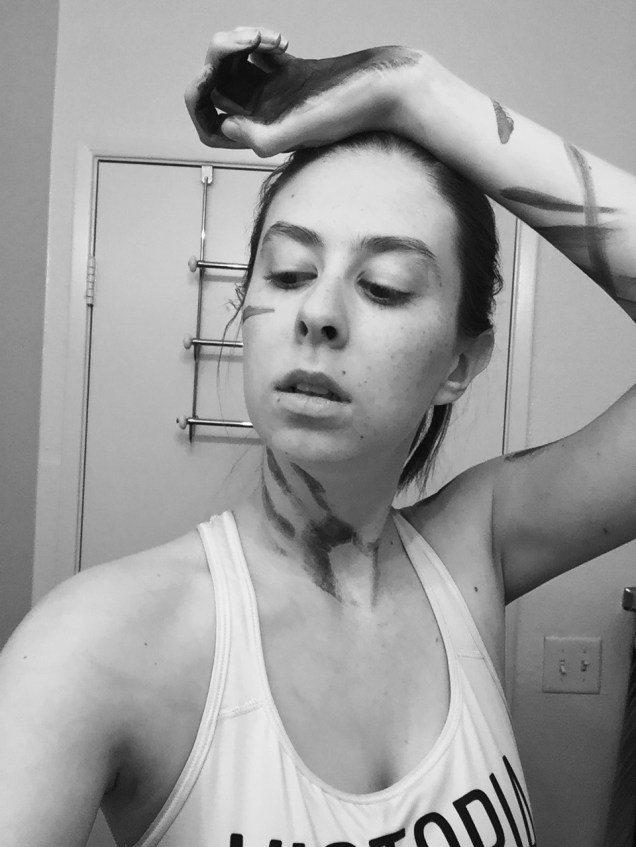
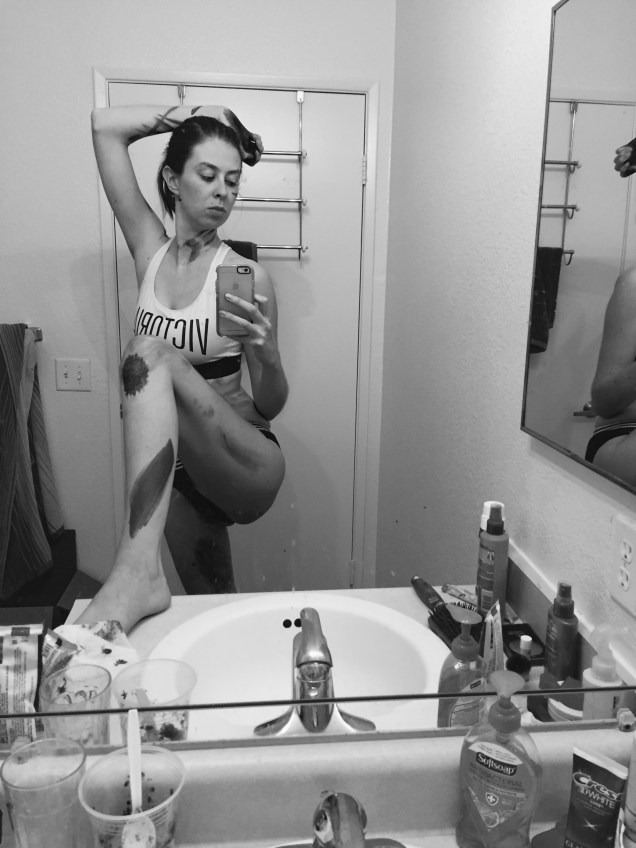
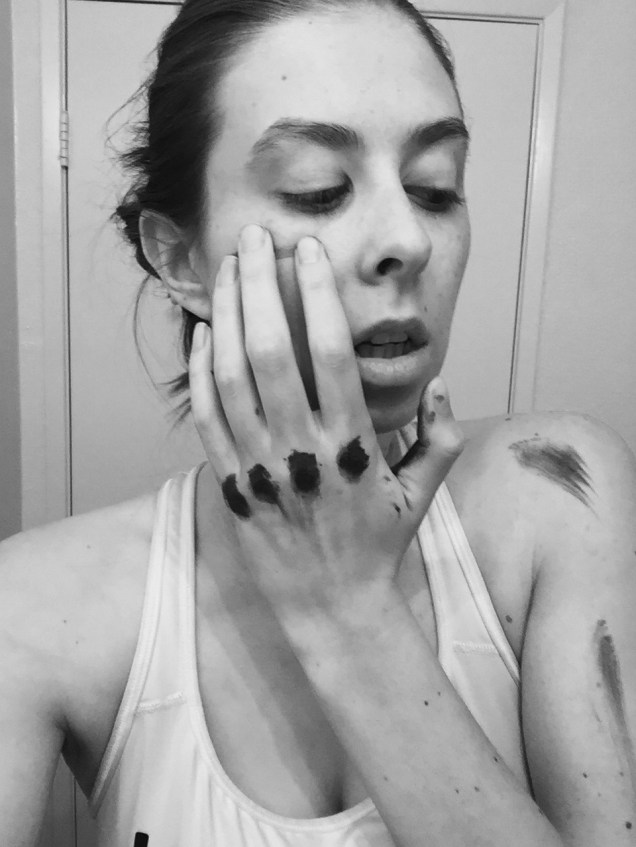
One day- I can’t tell you what was so special about this day- I decided to give my limbs and skin a break from the beating they were taking. And I picked up a paintbrush. Don’t ask me why I decided to opt for an art form I had never tried before. Sasha told me I was shit, and that I shouldn’t even try. But something in me told her to sit down, and she did.
Below you will see what came from this art project. It ended up moving me beyond belief and filling me in ways my self-harm never could. Suddenly, everything I was feeling was on my body. Better yet, it was temporary. Paint does no harm, and this was the day that my self-harm went into hibernation.
The poetry below represents my twisted thoughts during my self-injury period.
On April 3, 2018 I collected all of the items I used to harm myself and gave them to my therapist. I made a commitment to safety. To love my body and it’s beauty, with and without scars.
with hands around your throat
and scars across your face you have a story to tell that makes you more interesting than you were before the bruises will heal but the stories never will
skin is a blank canvas meant to be punctured with spatters of painted blood that turn something ordinary into something extraordinary
porcelain they call it
but they never understood something so empty and fragile was bound to break and create many more fragments to love
rest easy child i have you now your battles are mine to fight it’s time for you to let go and leave it to me
 putting down the rope