You and I both know we have a long history. I’ve been wrapped around your finger for years. Our hands stay intertwined no matter where we go, and when I can’t find you I panic. It helps that you’re gorgeous; everything I wish I could look like (and more). I think you did that on purpose. You see, while I was fawning over you for all this time, you figured out exactly how to keep me around. Promising a life of beauty, happiness, art, and endless pain to foster my creativity. After all, you were the one who told me good art comes from suffering. And I believed you for a long time. Until now.
I’m outing you, Sasha. You’re emotionally abusive, and I can’t take it anymore. It’s time to shine a spotlight on you in front of the world. You thrive in secrecy. The shadows is where you like to play. Not anymore. It’s time everyone knew you for who you are: an emotionally manipulative piece of garbage. In fact, you’re more like the gum someone scraped off their shoe and stuck to the garbage in the trash can. Someone close to me recently described you as a “bitch bag.” I’m sorry to laugh but…you know what, I’m actually not sorry at all.
I’ve written a lot of posts about you and your devious ways, Sasha, but I always end up slinking back to you at the end of the day. Desperate to cover myself under the cloak of your shadow. But this is my promise to fight you. To not let you seduce me into your twisted ways. To not hinder my recovery for the sake of your comfort.
So, there it is Sash. I’m declaring this our official breakup. I’m taking back the reigns from your thin, frail hands. I’m going to live my life now. Don’t let the door hit you in the ass on your way out.
The inspiration for this breakup is funded in part by Demi Lovato’s Sorry Not Sorry. Please find the lyrics here, as I have been playing it on repeat all day.
*If this post has left you thoroughly confused, please feel free to learn all about who Sasha is and why we are so codependent here.
My cousin, Kevin, invited me as a guest on his podcast, Capture the Conversation. We discuss my relationship with mental illness, my eating disorder, and how I aim to end the mental health stigma! I had a great time recording this episode with Kevin, and am humbled to have been asked to be his guest.
Click this link to listen, and my episode is #19 (aka the one published on 5/1/2018). Also, please check out the other episodes on Capture the Conversation!
Please take note that obviously I’m the superior KG among the two of us. Sorry not sorry, Kev.
I’m sitting on a stiff couch across from my therapist where I’ve just finished disclosing the reason my posts on the blog have been slacking lately. She’s sitting cross legged on her chair, peering at me through her stylish glasses (I swear, she has a different pair for each outfit. Ok, she only has three pairs, but still) and suddenly a smile creeps across her face. She maintains eye contact with me until I squirm. I know this look well. This is the “I, as your therapist, know what you need to do that you probably aren’t gonna like” smile. And let me tell you, she has mastered it.
This is my fourth month of treatment at this ED program, and I have had session with my therapist- we’ll call her Nikki- twice a week (sometimes three) and countless groups with her during this time. Nikki knows me pretty well at this point, and I like to think I know how she operates. At least on a professional level. Suffice it to say, I see her awkward smile a lot. Just as she has seen mine when I hand it right back to her.
I had just finished discussing the LA Times Festival of Books’ impact on me, which went something like this:
“I loved my experience there, and it was incredibly inspiring and motivating, and I feel like ever since I have been putting fifty shades of pressure on myself to be the best. I’ve been comparing myself to the authors I was meeting- even comparing myself to the other young adults around me- so much so that nothing I write now seems good enough.”
I don’t even know if the others in attendance were writers! But suddenly, they were better than me, and everything I’ve produced since has been hot, wet garbage.
Cue the derpy smile on Nikki’s face. I gave her an awkward toothy smile back as I braced myself for her feedback.
“That pesky perfectionism, am I right?”
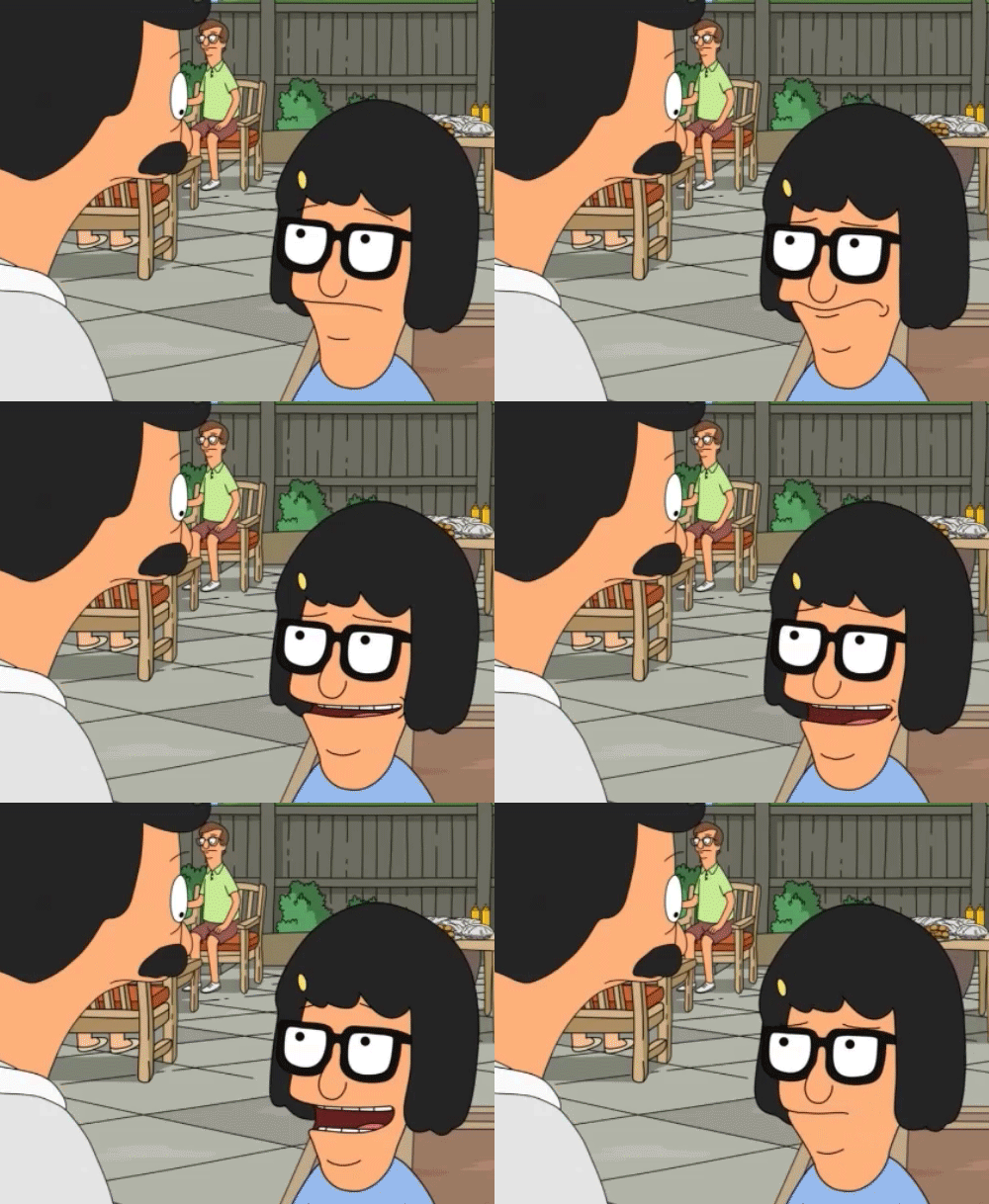
Ugh. Of course she brings up my perfectionism. And double of course that she instantly tells me I need to blog about the experience. Cue the Tina-esque groan on my end. (Any Bob’s Burgers fans in the house?)
I spent most of the day simmering about how I was going to frame this post. My only instruction was the write about my experience, authentically. What I landed on wasn’t the idea that thrilled Sasha. In fact, she’s a bit pissed. But I know that in order to truly be authentic, I should share the lies she’s been telling me.
Most of these stem from my experience at the Festival of Books last week (and beyond). As I mentioned above, while it was the most amazing event, I also left with a new load of worries. Particularly in Sandy and Michael’s panel, where I gloriously soaked up every ounce of insight they offered, I left with a fun little distortion filter Sasha slipped over my memories. I could now only focus on the insecurities that sprouted out of my mind, like weeds.
It’s a vulnerable thing to be sharing, and I know it’s the elephant in the room Sasha and I are crammed in together. Once one lie begins, shit begins to spiral:
My writing isn’t pretty enough. I don’t write in an eloquent way that commands attention, or in a way that stirs people when they read it for the first time. Or the second time. Or the eighth time.
My writing doesn’t use a lot of frothy, figurative language or intelligent vocabulary. I’m a literal person. I’m not great at writing anything worthy of formal publication.
My writing doesn’t delve deep enough, it merely scratches the surface. I’m not good at the whole “underlying meaning” thing. “Profound” is not a word you would use to describe my writing.
I don’t write in a compelling enough way; people read the blog out of pity or because of a flashy title. They think my writing is trash.
Super fun, right? Let me tell you, it’s a lot easier to ignore posting on your blog when you’re convinced anything you write is utter crap.
Hence, Nikki’s awkward smile. With one look I knew she was staring down Sasha, trying to kill her with the kindness of a too-wide grin. And when all was said and done, I knew I had to believe Nikki. She’s one of few who can see through Sasha’s mental filter to snap me back to reality, where my only worry is when I’ll have time to post on any particular day.
Because, after all of these toxic thoughts that have been flooding my brain lately- listening to Sasha’s lies and staying silent on this blog- has caused me to go against the entire reason I created the blog in the first place! To challenge my perfectionism, my social anxiety, and to put down the rope. Not only that, but to do it in a way that makes sense to me. That fosters creativity and allows me to run free amongst my thoughts, without abandon.
It may make me squirm, but Nikki’s smile is what pushes me to be effective. She knows exactly what to do to point out the elephant in the room that I share with Sasha. After all, I created this blog for me. And I don’t remember typing anything on the About page about succumbing to insecurities. Putting Down the Rope is mine, and I am here to stay.
Nikki may have mastered the awkward smile, but no one can top Tina Belcher.
Let’s talk about the fact that I had completely finished this post and then it all got erased and I had to start over. Talk about challenging perfectionism. (Still fighting those thoughts Sasha is feeding me about the post currently sucking in it’s new iteration. SHUT IT, SASHA!)
Happy #MentalHealthMonday, everyone! We have an exciting post today, because a dear friend of mine has agreed to be a guest here on Putting Down the Rope! She has written eloquently about her experience with anxiety. Please enjoy this essay by the one and only, Alex Dawson.
I’ve often perplexed at the conundrum of why I’m so keyed up. Is it a genetic misfiring? Clusterfucked logical processing? Ritualized catastrophizing? Internalized childhood bullying that’s crystallized into a repressed psychological wedgie? Do I need to pull myself together? If I could, wouldn’t I have done so already? Working with little more than a half-remembered skim-read of the psychoanalysis wiki page, it’d probably be an oversimplification to attribute the whole kit and caboodle of my neuroticism to one sole cause, but I often wonder.
Regardless of its source, anxiety can be poisonous and toxic. Small talk becomes ironically gargantuan. Typing out a simple smartphone message is emotional minefield hopscotch to where it’s best to merely avoid altogether. The present moment is a cigarette paper sandwiched betwixt mountainous pasts and futures. There’s insomnia. Chronic tension headaches. Last-minute plans are made to cancel current plans. Anxiety is the gospel of second-guessing, and it’s devastating. I’ve tried therapy. Medication. I’ve even considered neuro-genetic brain surgery that destroys the overactive amygdala in our brains. Then there are the panic attacks. The acute feeling of terror and dread is difficult to describe, though I’d imagine it’s a little like being slipped inside Satan’s insides. My breath races out of control. Heart turns pneumatic. My palms are sweaty, knees weak, arms are heavy.
It’s odd then, to admit that I’ve recently fallen in love with my anxiety, given that up until now it’s served as a seemingly endless torrent of negativity and hopelessness comparable only to that of the average YouTube or Reddit comment thread. Anxiety is a monster. It kills many. Debilitates many more. But as paralyzing as the anxiety kraken is, to be wrapped in its tentacles can be inexplicably comforting. It is a force at turns destructive and generative. It’s not that I’ve begun to fetishize my own self-destruction, but more the acknowledgement of a mushroom cloud’s silver lining. If, as Plato stated, “the unexamined life is not worth living, what could be more worthwhile than a zillion sleepless nights worth of excruciating self-examination?” Neuroticism, though agonizing, can be advantageous.
It’s also a creative stimulant. Although I get stuck in a cycle of fretting over what people will think of or perceive me, or what they will think of my work, it is what drives me to write stuff vaguely resembling something readable. Another benefit to putting on my overthinking cap? I’m always geared up for the worst-case scenario. You might prepare for a rainy day, but have you considered wind speed, temperature, humidity, acidity, and the possibility that this is a terrible analogy? Because I have. Several times over. And over again. And again.
When people imagine anxiety sufferers, they typically envision mumbling wallflowers that you read about in books or the comical characters like Sheldon and Lenard on The Big Bang Theory.
But I can be extroverted, even obnoxiously so. I worry people mistake my anxiety for misanthropy. It’s not that. I love people, so much so the mere thought of them judging me can be completely crippling. I’m an unpersonable people person. I’ll say the wrong thing in a conversation and have it haunt me for months or years afterwards like some kind of social anxiety poltergeist. Sometimes I avoid people. Intimacy frightens me. I’ve burnt more bridges than a pyromaniac with a fetish for architectural engineering. But at the same time, my anxiety has made me more vulnerable, honest, approachable, and willing to reach out and connect with people. Connection is the antidote for anxiety. Connection makes us feel whole and brings light to such a dark diagnosis.
My entire sense of identity is a construction founded on a litany of long-reverberating faulty deductions and assumptions. A self-love deficit can usually be plugged with laughter and saturated fats. Ultimately, if I feel anxious about something, that means I’m emotionally invested in it. I’m grateful I care so intensely about things. It certainly beats the alternatives of numbness, social insensitivity, even blissful ignorance that I craved for so long.
Anxiety disorders are becoming increasingly prevalent even more so than the common cold. Our age is an acutely nervous one. We long for recognition and validation and approval. Who could tolerate being unknown and ignored on our so called blue orb? So we’ve created cameras in droves, on drones and phones, mounted onto Google goggles or selfie-sticks, or tripods or iPods or laptops or atop the tips of dildos. To traverse any public space is to navigate a kingdom of lenses. We have an innate desire to document our lives, and we use it as a means of justifying our existence. We need to be observed. We tweet ourselves dry. We become reality tv contestants. We measure our self-esteem according to likes and shares and retweets.
Be it wealth, fashion, physical attractiveness, romance or otherwise, we are all desperately clambering for symbols of status. It’s a recipe for worriment. But we are not, by nature, egoistic wolves, ravenously clawing for material goods. Compassion and co-operation are neurologically hardwired to our very core.
Self-consciousness, even anxiety and second-guessing, can be beautiful, if we harness it to reflect on our routinely overlooked capacity for immense kindness. But maybe the universe only peopled some people into existence so it could reflect on itself.
This weekend I was in Los Angeles attending the LA Times Festival of Books, aka, my own personal heaven. I attended panels by beloved authors and poets, met new people, took many pages of notes, and peed in a hot port-a-potty. It was a weekend fueled by creativity, coffee, and the desire to learn as much as possible.
In a way, this weekend was both terrifying and exhilarating. I felt drawn in to the high of art and writing and creating; the authors before me had been successful, why couldn’t I? Each panel delivered unique advice that I scribbled in my notebook as fast as my hand could move. I felt prepared in a way I hadn’t before; reassured that I was doing everything “right,” even though art knows no right or wrong.
At the same time, I felt like a grain of sand at the bottom of the ocean. There was so much talent surrounding me, and the eloquence that poured off of the lips of these writers intimidated me. How could I write something as profound as them, or even come close? As I listened to them describe their writing processes and meeting deadlines for their editors, I was overwhelmed. My head swam with toxic thoughts of incapability and impossibility; how would I ever be able to do anything like this?
Like waves lapping on shore, my stress ebbed and flowed. One poet during the first panel of my weekend adventure mentioned that he was not “a sophisticated thinker” like the others he was sitting next to. And yet, I was captivated by his perspective and story, and felt more connected to him than the others. I remember thinking, “Well he claims he’s not a sophisticated thinker and neither am I. But if he can get this far, maybe I can, too.”
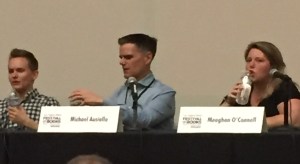
The panel I had been waiting for all weekend arrived, and I was fighting through some gnarly GI symptoms that I had woken up with that morning. I’d be damned if I let my chronic illness stop me from being in the same room as the author of one of my favorite memoirs. I popped some Pepto, took a deep breath, and braced myself for “Memoir: The Unexpected Hard Stuff,” with authors Sandy Allen, Michael Ausiello, and Meaghan O’Connell. With my notebook in my lap, and my pen poised, I was ready to absorb everything they had to offer.
I ended up not taking notes at all, too enthralled with what each author was saying to bear ripping my attention away, even for a moment.
iPhone realness: L to R, Sandy Allen, Michael Ausiello, Meaghan O’Connell
Each panelist spoke beautifully about their process and challenges they faced while writing their respective books. I was fascinated by Sandy’s story; their book was written over a period of 8 years after their uncle had shipped them a messy manuscript of his life and his schizophrenia. Sandy spoke beautifully about what it’s like to write nonfiction, and all of the hard work that is required to do justice to a person’s life.
Michael spoke next about how difficult it was for him to write about something so tragic, so traumatic, so soon after the death of his husband (which is what his memoir is about), and yet, how writing helped him make sense of the tragedy and how he felt his late husband’s story deserved to be told. He wanted to introduce the world to the man he loved. How powerful stories can be that each person who approached Michael that day, hands slightly shaking as they handed him their own precious copy of his book to be signed, had (or will have) their own experience while reading it. Each took something different from each page compared to myself or anyone else waiting in line, waiting for the author to crack open the cover and write them a message on the title page of his book.
Never would I have thought that at the LA Times Festival of Books, in front of a panel of esteemed writers, I would overcome a major social anxiety exposure. At the end of each panel, there is time for a few questions from the audience. As I am always fearful of how I will be judged or perceived, I usually keep my mouth shut in situations like this. But three brilliant writers were sitting across from me, having accomplished what I strive for in writing about my pain. I couldn’t leave without speaking to them directly.
I had my question ready the moment the moderator sent the first question down the line; each author responded very differently to how they crafted their work, and how long it took them to write about things that are painful. My perfectionism kicked in, as I realized my question lacked form in most respects, but I let go of that judgment so that I wouldn’t miss any of what was in front of me because of the chatter in my head.
I found myself fully present in listening to each author’s response, though my heart would skip a beat when I thought about my question. I was worried I would forget it and make a fool of myself. In previous panels, audience members who wanted to ask questions at the end of the panel were brought a microphone to their seat by the volunteers of the festival. You could stay seated or stand, and I was comfortable with this. I could ask my question while still remaining “safe” next to my friend, in my seat. I was still blended into the crowd. But of course, the universe knew I was working through an anxiety exposure, so when it was time for the Q&A, those who had questions were asked to step down to the very front to whichever microphone was closer- there was one stationed on the left and right of the stage.
Hell no, I thought. I was not about to embarrass myself by standing in front of everyone and asking my not-yet-fully-formed question. How would I stand? Would I cross my arms as I waited behind the other woman with poofy blonde hair who had already positioned herself at the mic closest to us? Would I draw my hands together behind my back, or should I let them fall by my side like limp noodles? Seeking final reassurance, I leaned over to my friend as the woman on our side addressed the panel. “I want to ask a question, should I go up there?” I whispered, as inconspicuous as I could manage. I didn’t want to come across as disrespectful by talking in the middle of the Q&A. My friend smiled and nodded vigorously as the poofy-haired woman wrapped up her question and stepped away from the microphone. I slipped out of my seat and down towards the stage, praying that I looked confident despite my strong desire to become endowed immediately by Harry Potter’s invisibility cloak.
I wound up being the last question of the day, an honor I received anxiously, as I peered around to make sure someone with a more eloquent or pressing question was waiting in the wings behind me. There was no one. All eyes were on me, and I was the only one in the room standing. I smiled awkwardly, leaned in towards the microphone, and began to speak.
The mic wasn’t working. No one could hear me. Of course the microphone wasn’t working! Michael looked at me and said, “Use the microphone!” to which I nervously called back, “I don’t think it’s working.” So, naturally, the moderator had the girl with social anxiety cross in front of the entire audience, directly in front of the panel (including the author she admires), to the microphone on the other side of the stage. When I had finally obtained a working mic and the audience had died down after the laughter that ensued my impromptu runway walk in front of everyone, I cleared my throat and began to speak. This time, my voice echoed through the lecture hall, and I made eye contact with Michael.
I definitely rambled, but managed to form my question in a way that could actually be responded to. If memory serves, it went something like this:
“I’ve heard before that when writing about trauma, there is a Three Year “Rule” to abide by; you should wait three years after the traumatic event to begin writing, to give yourself some distance and perspective on the experience. I was so interested in the time it took you and Sandy to write your respective books, and how different each process was. I’m curious, do you think if you had waited until after you had gotten some distance from the tragedy, you would have produced a similar result? What is your opinion on the difference between waiting or writing during the grieving time?”
With quivering legs I waited for his answer. The moderator jumped in by “correcting” the Three Year Rule I had mentioned; “That’s not really a ‘rule’ necessarily,” she said to me, causing me to blush and my anxiety to rise. Of course, I had not planned on following the so called “rule” that I had heard the day before, but was merely curious about how writing about personal trauma is different for everyone. I pushed away the thought that people in the audience were judging me for mentioning this Rule, and focused on what Michael had to say.
First, he thanked me for telling him that I had loved the book (I wasn’t sucking up, I genuinely loved it. Everyone go out and buy yourself a copy.) and then dove into his answer. He mentioned how he wouldn’t have written the book had he waited. Writing it so soon after his husband’s death gave him a fresh perspective; the memories were still vibrant in his mind, and he knew that if he waited, he wouldn’t get the opportunity to tell his husband’s story the way it deserved to be told.
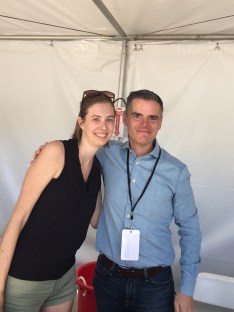
This ended up being the response that catapulted me into a discussion with Michael at the signing afterwards. I expressed how writing through pain and chaos is a way for me to make sense of what I’m going through, and ultimately, helps me get through it. I ended up telling him I’m in treatment for an eating disorder, and if I didn’t write about it, I would be in a very different place. I was able to tell one of my favorite authors that his book helped me through a very difficult time, and that I was so grateful to him for writing it. It was a great ending to a phenomenal (albeit, stressful) morning.
Meeting Michael Ausiello
This festival as a whole was so brilliantly designed. Each panel audience stocked with seasoned readers and writers, as well as those who didn’t know who most of the authors were, but were curious about their topic at hand. (Except for the man who fell asleep and started snoring during the Poetry: Trauma and Beauty panel…maybe he had just had a long day.) From the nerds to the newbies, there was something for everyone; some piece of advice or line from a book or poem that someone grabbed onto and will keep in their memory bank forever.
That is what great art is about. Everyone will interpret experiences differently, and that is the beauty and power of great literature, art, poetry, theatre, film. The world is endless, and I am small in a sea of stories waiting to be told.
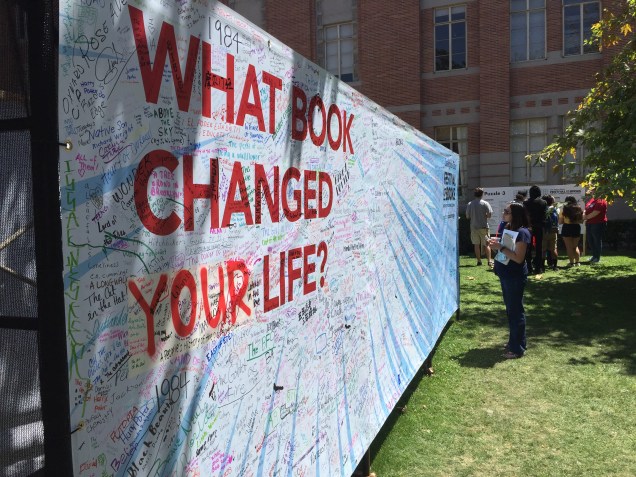
My contribution to this wall: “The School Story,” a children’s novel by Andrew Clements. It was the first book that gave me hope as a young girl that I could be a writer.
PS- I originally wasn’t going to disclose the book I wrote on the wall above for fear of being judged for it (#socialanxiety) but my copy of this book is worn with pages falling out because of how many times I read it growing up. Hell, I read it a few weeks ago to find some inspiration, and it was just as good as the first time I read it. The book that changed your life doesn’t have to fit a certain mold or be any profound piece of literature. It can be something as simple as a children’s novel that sparked inspiration and power within you.
Books You Must Read:
Spoiler Alert: The Hero Dies Michael Ausiello A Kind of Mirraculas Paradise: A True Story About Schizophrenia Sandra Allen And Now We Have Everything: On Motherhood Before I Was Ready Meaghan O’Connell
blood is not paint
sharp edges are not a paintbrush
art is not defiling your body
with scars and bruises
it is not as beautiful as you think
there are other things more exquisite
take the sun
setting over the ocean
melting its rays into the
churning water
or a mountain silhouetted
against a pink and purple sky
as if it is not a natural creation
or a painting made of watercolor
capturing a woman mourning
the loss of her home
art can be painful
but art is not created
at the expense of physical pain
you do not shed blood
to become more beautiful
you are beautiful
you are art
in its most natural form
I remember in junior high a friend of mine was in the car with me as we listened to a CD I was really excited about; I probably got it as a gift, as I have the tendency to listen to the same thing over and over if I’ve just discovered it. We reached a track I loved, and I turned to my friend and said “This one’s my favorite!” She gave the first few seconds a listen and then replied “You really like this type of music, don’t you?” with a judgmental, mocking tone. That’s the first memory I have of feeling ashamed about my taste in music.
And then came school dances, when I was the only one who wasn’t singing along to most songs blaring over the loudspeakers. College parties were worse. And post-college. And…right now.
In program today we were discussing how to establish relationships with people we encounter regularly, like folks in program or work or some such thing. Someone asked how we get the conversation going, which is how we got on the topic of music. I had a bit of a revelation sitting there while our therapist discussed how music can be an incredibly vulnerable thing.
I had made a Spotify playlist for the new year, and I realized 2/3 of the songs in the playlist I had chosen because I thought that’s what I should be listening to, but not actually what I wanted to be listening to. In fact, when those songs came on and I was alone in the car, I would skip them. And skipping 2/3 of a playlist leaves you with very little. But on the off chance that I would be driving someone around in my car, I wanted to make sure my music was good enough; I didn’t want to be judged or mocked or told I wasn’t cool because of the music that I listen to.
When I admitted this revelation to the group I felt shame, but also a bit of relief. I had buried this inside of me for so long, it was nice to share it in such safe environment. Not only that, but to get validation from others that I’m not alone in that, because music is a very vulnerable thing. One of my friends mentioned, “It’s like having someone read your diary.”
This revelation got me thinking about how often I am in my car and how I listen to music every time I’m driving anywhere- even if it’s two minutes away. Why should I let my social anxiety get in the way of something I enjoy so much?
That said, I decided to make myself a challenge in group today to create a new Spotify playlist that is 100% for me, and not for anyone else. Another friend of mine chimed in and mentioned that I should blog about the experience. So, here I am.
Let me tell you, this mental filter I’ve got with music runs deep. I had to think very mindfully about the music I was adding. And, of course, my perfectionism kicked in and fed me all kinds of lies about how the playlist looked, and how long or short it was, and certain artists I was including. I still think the playlist is far from perfect, but I realize that it’s not something that’s permanent. I can constantly be switching things around if I want to, and I’m allowed to be bored with certain songs. Just because I find it boring, doesn’t mean I’m forced to keep listening to it.
As promised to my accountability buddy (you know who you are), below is my playlist. Love it or hate it, I don’t care. This is mine.
For those who don’t know, or who didn’t see my post explaining the three states of mind, I personify my emotion mind since she’s usually the one taking control. Her name is Sasha. She’s a sly fox, a devil in disguise, and of course, she’s drop dead gorgeous. Her goal in life is to hurt me, make me jealous, spiteful, unhealthy, and impulsive. So far, she’s done a pretty good job of it. This #MentalHealthMonday is my middle finger to her.
Lately Sasha has been in my head non-stop. She’s been convincing me that I’m not good enough. Not talented enough. Not pretty enough. I’m technically underweight and yet Sasha tells me I’m not thin enough. She sees all the fat that hangs from my bones and puts a fun house filter on my eyes when I look in the mirror. She convinces me that food is unsafe and will do me harm. For a long time, she convinced me to lie about these feelings. To my friends, family, and treatment team, I was on the road to recovery; progressing steadily. On the inside, however, Sasha was telling me that if I told anyone my secret, they would make my life a living hell. They’d force me to eat, step me back up in care, and ultimately, judge me for not being the perfect patient. So for weeks I stayed silent. This past weekend, however, I think Sasha needed to get a drink of water after spending so much time yelling at me. During the silence of her sips I could hear the whisper of my wise mind telling me to come clean and that things will be better when I do. Within a split second, Sasha was back, jumping up and down, ready for a fight.
I clung to that small voice, though; the one telling me I could do it successfully. I could be honest. So I reached out to a few friends from my ED program and confessed to them. They were completely understanding, and encouraged me to share what I was going through with my therapist. Sasha threw a temper tantrum. But even so, my wise mind’s voice got a little louder.
Sasha gets scared easily. Usually it’s because she feels like the spotlight is no longer on her, or when I witness bravery in others and feel inspired to be brave myself. Sasha does not want me to be brave. She needs me dependent on her, otherwise she will waste away in the back corner of my mind. One morning at clinic, before breakfast, one of my friends- a fellow patient- stood up, marched to the middle of the room, and lay her sneakers down in front of us. Crying, she said that she was giving the shoes to her therapist so that she would not be tempted by her eating disorder any more.
It was the bravest thing I had ever seen. Someone not so different from me stood up, said to her disorder “I choose life, I choose freedom,” and willingly gave up the most secure, comfortable, unhealthy part of her. I could see how hard it was on her face. And I could see the hope that shone through the hurt and despair. I will never forget that moment. The memory is burned into my brain, never to be removed.
I felt Sasha shudder that morning. Bravery was not something she wanted me to get accustomed to. Bravery meant I could stand up to her, to fight for my right to be happy and healthy. It was because of that recollection of bravery that I reached out to my therapist on a Saturday night and admitted that I wasn’t ok. That Sasha had tricked me, and was continuing to lie to me about my worth. As soon as I let the truth slip, Sasha created a storm in my head. Regret, self-hatred, and hopelessness flooded my mind, and I wished I could take it all back. I was comfortable in my disorder. I was on track to lose the weight I wanted to lose, and I stopped myself. It was difficult to separate Sasha from myself that night. To realize that what I had done was brave, and that I was taking back control of my life and my body and my health.
As you can imagine, Sasha is not pleased that I am showing her hand to all of you. She knows that this means it will be harder for her to lie to me, to seduce me back over to the dark side. And to that I say: Screw you, Sasha. It’s time for you to sit down and knit a f#cking sweater.
(I swear I had this drafted and ready to go before the clock struck midnight, but then I had to be an adult and finish my taxes. It’s only 90 minutes after Monday, so I’m still counting it as a #MentalHealthMonday post. Try and stop me.)
i stare dead into the face
of my disorder
it is beautiful
a ravenous glow
that makes me hungry
for the beauty it possesses
it pulls me towards it
stimulated
i sway towards the light
moving through a thick fog
when from behind i feel
my name trickle into
my consciousness
the glowing light in front of me
suddenly flares as i
turn to the direction of
the voice
the light so blinding
it’s hard to make out shapes
colors seem distorted
there it is again
my name like silk
like something familiar
calling me home after a long day
through the ether hanging like a
curtain upon my eyelashes
a form materializes
and i can make out
an outstretched hand
i walk towards it
the warmth from the mass of light
behind me flutters
against my skin
as i spot another form
another hand stretched towards me
welcoming
comforting
the two forms are shoulder to shoulder
when another joins them
and another
until there is a sea
an army
reaching out for me
and i realize
they aren’t anonymous creatures
they are women
each with a distinct aura
all radiating care and love
they seem resistant to the illumination
that i have left in my wake
and their hands seem soothing
like a still pool of water
the heat continues to shroud me
yearning for me to reciprocate
and envelop it’s rays
yet there is something so magnetic
that allows me to reach out
and grasp at the closest hand
there is a slight shudder
a disturbance in the temperature
and the woman reaches up
with her other hand
and douses my eyes
with her fingers
washing away the curtain
and i feel a change
a match struck
when i turn to face
the warm glow of my disorder
i find that it is a roaring fire
sparking and spitting
angrily towards me
i look down at my clothes
they are singed and smoking
falling from my body like ashes
it’s as if a kaleidoscope is removed
from my vision
changing the soft light
to an inferno
that was burning me alive
engulfing my existence
i step back into the arms of the
women that surround me
forming a wall that withstands
the increasingly burning ugliness
cooling my skin as they
barricade me from the blaze
they guide my mind
teaching me how to
douse the flame
-to the army of women on staff at my treatment center. this is for you.
Happy Friday, the 13th! I hope everyone is avoiding walking under ladders and stepping on cracks.
This post was inspired by my dad, who doesn’t believe in all of those superstitions that freak people out on this unlucky day- or any day, for that matter. For example, let’s say in a baseball game the pitcher is throwing a no-hitter, and it’s the top of the ninth inning. However, as soon as the sportscaster mentions it, suddenly the opposing team hits the ball and the no-hitter is no more. People tend to blame the sportscaster for “jinxing it” — my dad thinks that’s a load of crap. His words didn’t magically fly through the air waves and land in the pitcher’s arm. But to some people, they believe in that superstition.
In my experience, I am not superstitious about stuff like that (though I used to be when I was younger; whenever I received a chain email, I had to forward it, otherwise I would never find love or I would die a tragic death or something), but I actually do tend to be more superstitious about more tangible things.
I have what’s called “emetophobia” which basically means I have a fear of vomit. I know some of you will relate and say “Yeah, I can’t stand vomit, too,” but I want to separate fear from phobia. You can fear something and not have a phobia of it. It’s when the aversion or fear becomes so irrational that it affects your daily life that it becomes a phobia. So, I developed anxiety, OCD tendencies, and an eating disorder because of my phobia.
You could argue that the phobia is currently at its peak, because I’m in treatment for my ED now. However, I had another significant peak when I was younger, in junior high and the beginning of high school.
I grew up with chronic nausea, and became terrified of getting sick. I fell asleep on the bathroom floor more nights than I was in my own bed, and pretty soon my parents were fed up with me running to the bathroom out of fear and falling asleep there every night (hello, germs!). So, I started just going with it and falling asleep in my bed. However, I had a very specific regime to follow, and if I didn’t follow it exactly I knew it would make me sick.
To start, I’d have to make sure I had a plastic bag hanging off the left side of my headboard on my bed. I had to get in bed from the left side, and use my right hand to set my alarm clock and turn off my lamp. Once I laid down, I had to start on my right side, then after a certain number of minutes flip to my left, then back to my right- only if I turned inward so my stomach touched the mattress as I turned. Eventually, I could then get in the position that was most comfortable for me and drift off to sleep.
My superstitions were so deeply rooted in my brain, that I would have somatic symptoms if I didn’t follow my routine. Even today- though not as severe as they once were- I experience some of these superstitions. For example, I have to brush my teeth in a very specific way, otherwise I’m convinced that something will go wrong later in the day if I don’t.
Earlier, when I was on the phone with my dad, he asked me if I believed in that “superstitious stuff,” and I said no. Which is true; I don’t believe walking under a ladder or seeing a black cat cross the path in front of you will do anything to you. However, I am definitely superstitious in other ways that I didn’t even think about until after I hung up the phone with him. Granted, my superstitions are more likely categorized as OCD behaviors rather than superstitions ones. Nonetheless, these beliefs foster a real fear in me, as I’m sure it does in others, which is almost worse than watching a movie about a man in a hockey mask murdering people.
On this Friday the 13th, I am setting a goal to brush my teeth in a different order tonight. Because if a cat can’t ruin my day, why should a toothbrush?

 putting down the rope